
How to Opt Out of PeopleFinders (2026)
Remove your PeopleFinders record for free with an email link and one form, and what to do if your request is denied
Updated
PeopleFinders is one of the oldest people-search sites in the US. A record can show your current and past addresses, phone numbers, age, and relatives, and PeopleFinders sells fuller background reports on top of it. It says its data comes from public records and publicly available sources "like voter records, phone directories, and property records."
Opting out is free and takes about five minutes: you ask for a link by email, then fill in a form with the details shown on your record. What most guides don't mention is how often it fails. In 2025, PeopleFinders turned down 70% of the opt-out requests it received. Here's how to fill in the form so it finds your record, and what to do if you're refused.
PeopleFinders Opt-Out at a Glance
Opt out ofPeopleFindersHow we checked this guide: On November 22, 2026, we went through PeopleFinders' opt-out from a US connection: we requested the email link, opened it, and filled in the Record Suppression Form, stopping before the final Submit button. We didn't remove anyone's record. Quotes come from the opt-out page and its FAQ, the email PeopleFinders sent, its Privacy Notice, and its U.S. State Supplemental Privacy Notice, which includes the 2025 request figures.
How to Remove Yourself From PeopleFinders, Step by Step
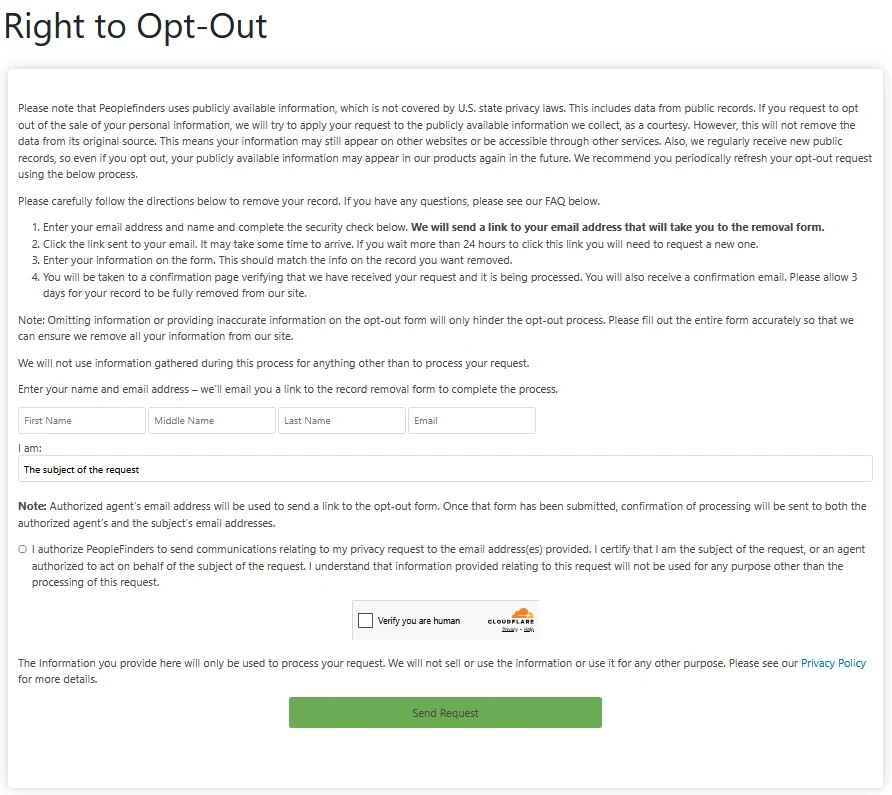
[email protected] with the subject "Complete your peoplefinders.com Privacy Request." Click Click here to fill out the form. The email warns: "If you waited longer than 24 hours to click the link below, you will need to start over and generate another link."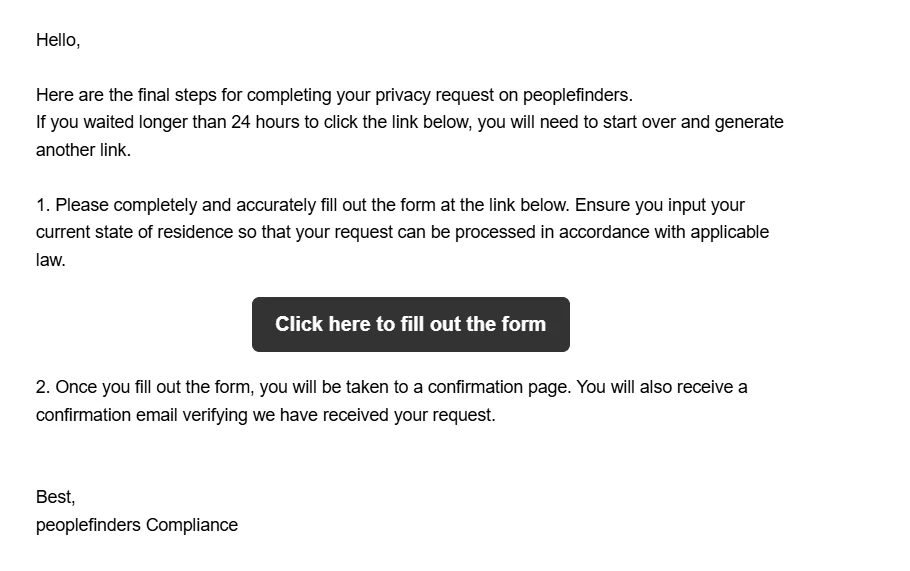
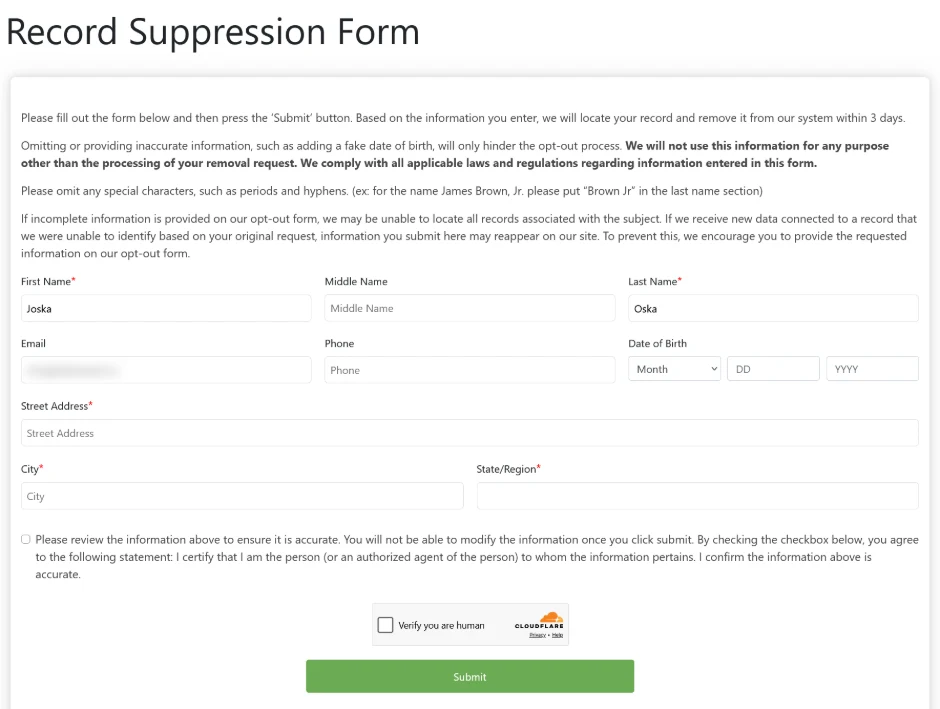
Shortcut without the email: The same Record Suppression Form also appears further down the opt-out page, where you can fill it in directly; the email field there is optional. We recommend the email route above: it's the process PeopleFinders describes step by step, and it's the one where it promises a confirmation email, which is your proof of the request if you need to appeal.
Skip the Upsells
PeopleFinders offers two things along the way that you don't need:
- Free Identity Monitoring. It sits on the opt-out page next to the opt-out itself and promises to let you "claim your report," scan the dark web, and alert you to new records. Signing up isn't part of the opt-out and gives PeopleFinders more information about you.
- BrandYourself. After you send the request, the "Email Sent" page recommends PeopleFinders' partner, BrandYourself, with a "Remove my info from over 20 websites" button. That's a paid removal service; your PeopleFinders opt-out doesn't depend on it. If you want a service to do this for you, compare the options first (see below).
If Your Opt-Out Is Denied
PeopleFinders publishes how many privacy requests it handled. Its figures for 2025 cover requests from residents of all US states, not just California:
| Request type | Received | Fully completed | Denied | Median reply time |
|---|---|---|---|---|
| Opt out | 773,547 | 228,704 | 544,843 (70%) | Under 1 day |
| Delete | 2,847 | 0 (all 2,847 in part) | 0 | Under 1 day |
| Know (access) | 199 | 37 | 162 | 30 days |
Source: PeopleFinders' U.S. State Supplemental Privacy Notice. Deletions "complied with in part" are cases where it kept some data under exemptions in California law.
PeopleFinders says opt-outs were denied when "the data subject was determined to not be a covered consumer under an applicable consumer privacy law" or when it was "unable to locate relevant records in our system." It doesn't say how many fall into each group. Its opt-out page explains its position: PeopleFinders "uses publicly available information, which is not covered by U.S. state privacy laws," and if you opt out, "we will try to apply your request to the publicly available information we collect, as a courtesy."
For comparison, TruePeopleSearch reports denying 33% of opt-outs in 2025, using the same reasons and the same "courtesy" wording (see the TruePeopleSearch guide).
If you're turned down:
- Make sure it isn't a mismatch. A record PeopleFinders can't find counts as a denial too. Send a new request with the address, middle name, and date of birth exactly as they appear on your record, and a separate one for each old address it lists.
- Check whether your state has a privacy law. 19 states give residents the right to delete their data — see which US states give you the right to delete your data. Always select the state you actually live in; the form asks you to certify that your details are accurate.
- Appeal. PeopleFinders' privacy notice says you can appeal using its Appeal Form, linked from the Privacy Notice, or by calling (877) 551-9688. If your state has a privacy law, name it.
- Ask for the courtesy opt-out. If your state has no privacy law, call (877) 551-9688 or write to
[email protected]and quote its own words: it "will try to apply your request to the publicly available information we collect, as a courtesy." - Remove the Google result. Google's Results about you tool can remove search results that show your phone number, email, or home address, even if the record stays on PeopleFinders.
What the PeopleFinders Opt-Out Doesn't Remove
- The original records. PeopleFinders says removing your information "will not erase it from its original sources," so voter, property, and court records stay where they're published.
- Other people-search sites. PeopleFinders says it "can only remove information from our own site." Spokeo, Whitepages, TruePeopleSearch, and the others each need their own request.
- New records. PeopleFinders says it regularly receives new public records, "so even if you opt out, your publicly available information may appear in our products again," and recommends that you "periodically refresh your opt-out request."
- Search engine copies. PeopleFinders says it notifies search engines when it removes a record but can't control how fast they update. Use Google's Remove Outdated Content or Bing's Content Removal tool.
- Tracking on the site. The opt-out covers your record, not the cookies PeopleFinders and its advertising partners set when you visit. Its privacy notice says you also need to change your cookie settings or send an opt-out signal such as Global Privacy Control.
If Something Goes Wrong
| Problem | What to Do |
|---|---|
| You get a security check or an error page | PeopleFinders runs Cloudflare checks on the opt-out page. Complete the "Verify you are human" box, allow cookies, or try another browser. If you use a VPN, switch to a US server or turn it off for a moment. |
| No email arrives | Wait a few minutes and check your spam folder for "Complete your peoplefinders.com Privacy Request" from [email protected]. If it isn't there, go back to step 1 and check the spelling of your email address. |
| The link has expired | The link works for 24 hours. Start again from step 1 to get a new one. |
| You made a mistake in the form | You can't edit a submitted request. Send a new one with the correct details. |
| Your record is still there after 3 days | Clear your browser cache and search again. If it's still there, send a new request with the details exactly as the record shows them, or call (877) 551-9688. |
| Your request is denied | See If Your Opt-Out Is Denied: check the details, then appeal with the Appeal Form or by phone. |
| Your record comes back months later | New public records can create it again. Repeat the opt-out; PeopleFinders itself recommends refreshing it periodically. |
Your Other Privacy Rights With PeopleFinders
- Opt out by phone. PeopleFinders' privacy notice lists (877) 551-9688 as an alternative to the online form, for opt-outs, corrections, and appeals.
- See what PeopleFinders has on you. Use the Right to Know page linked from its privacy notice or call (877) 551-9688. It reports a median reply time of 30 days, and it denied 162 of 199 such requests in 2025. The reasons it gives: the person wasn't covered by a state privacy law, couldn't be verified, or had no matching record.
- Correct wrong information. If you're not a member, PeopleFinders doesn't offer corrections: it points you to the same opt-out form to hide the record instead.
- Authorized agents. Someone else can submit a request for you. PeopleFinders may ask for a signed authorization and may ask you to verify your identity directly.
- Members. If you have a PeopleFinders account, you can delete it from your account settings or by calling (800) 718-8997, and correct it by writing to
[email protected]. To hide your public record, use the opt-out above.
PeopleFinders' privacy notice says that "opt-out requests do not require verification," and that it doesn't process sensitive personal information. It is run by PeopleFinders, LLC, says it is registered as a data broker in Texas, and states that it "is not a Consumer Reporting Agency," so its reports can't legally be used for decisions about credit, jobs, or tenancy. Contact: [email protected] or (800) 718-8997. It doesn't list a mailing address for privacy requests.
Live in California? The state's free DROP platform sends one deletion request to every registered data broker at once. Do it in addition to the PeopleFinders form, not instead of it.
After PeopleFinders: Where to Opt Out Next
PeopleFinders is only one site. If you want your address off the first page of Google, these are the next ones to tackle:
- Spokeo — email link, 24–48 hours
- ThatsThem — one form, no verification link, typically 72 hours
- Whitepages — phone call, up to 72 hours
- BeenVerified — email link, about 24 hours
- TruePeopleSearch and FastPeopleSearch — email link, up to 3 days
- PeopleConnect Suppression Center — one request covers Intelius, Instant Checkmate, TruthFinder, and US Search
- MyLife — email code, median 5 days
- CyberBackgroundChecks — email link, up to 3 days
- FamilyTreeNow — same steps as TruePeopleSearch, up to 3 days
To see what your IP address and internet provider already reveal, run the free Data Broker Exposure Report. It's also worth checking whether your email has shown up in a data breach — breached data is another common source for people-search profiles.
Don't Want to Repeat This Every Few Months?
The free form works, but PeopleFinders isn't the only site, and new public records can bring your record back. Paid removal services check people-search sites for you and keep re-submitting opt-outs. If that's worth it to you, see the comparison of Optery, Incogni, and DeleteMe — what each one covers and what it costs.