
How to Opt Out of AdvancedBackgroundChecks (2026)
Remove your AdvancedBackgroundChecks record for free with two short forms and one email link, and why a deletion request won't work
Updated
AdvancedBackgroundChecks promises "completely free" people search with "no sign-up required," and it delivers. Search a name, phone number, address, or email, and each result shows age, current city, past cities, a partly hidden phone number, other names, relatives, and associates. Open a record and you get birth month and year, every phone number with its carrier, email addresses, two dozen past addresses with dates, family members, and a written "Background Profile" that strings it all together.
The opt-out is free and takes about five minutes. It's the same system TruePeopleSearch and FamilyTreeNow use, and in 2025 it worked for most people: AdvancedBackgroundChecks completed 81% of opt-out requests. But it also received 11,176 deletion requests and denied every one. So use the opt-out form, fill it in exactly the way your record reads, and skip the red button that looks like the next step. Here's how.
AdvancedBackgroundChecks Opt-Out at a Glance
Opt out ofAdvancedBackgroundChecks
How we checked this guide: On November 26, 2026, we went through AdvancedBackgroundChecks' opt-out from a US connection: we searched the site, requested the email link, opened it, and reached the final opt-out form, stopping before the Submit button. We didn't remove anyone's record. Quotes come from the opt-out pages, the email AdvancedBackgroundChecks sent, its Notice of Right to Opt-Out (last updated April 15, 2026), its Privacy Notice (last updated August 4, 2026), its U.S. State Supplemental Privacy Notice (last updated July 1, 2026), which includes the 2025 request figures, and its Terms of Service (effective August 19, 2026). The operator comes from the California Privacy Protection Agency's 2025 data broker registry.
How to Remove Yourself From AdvancedBackgroundChecks, Step by Step
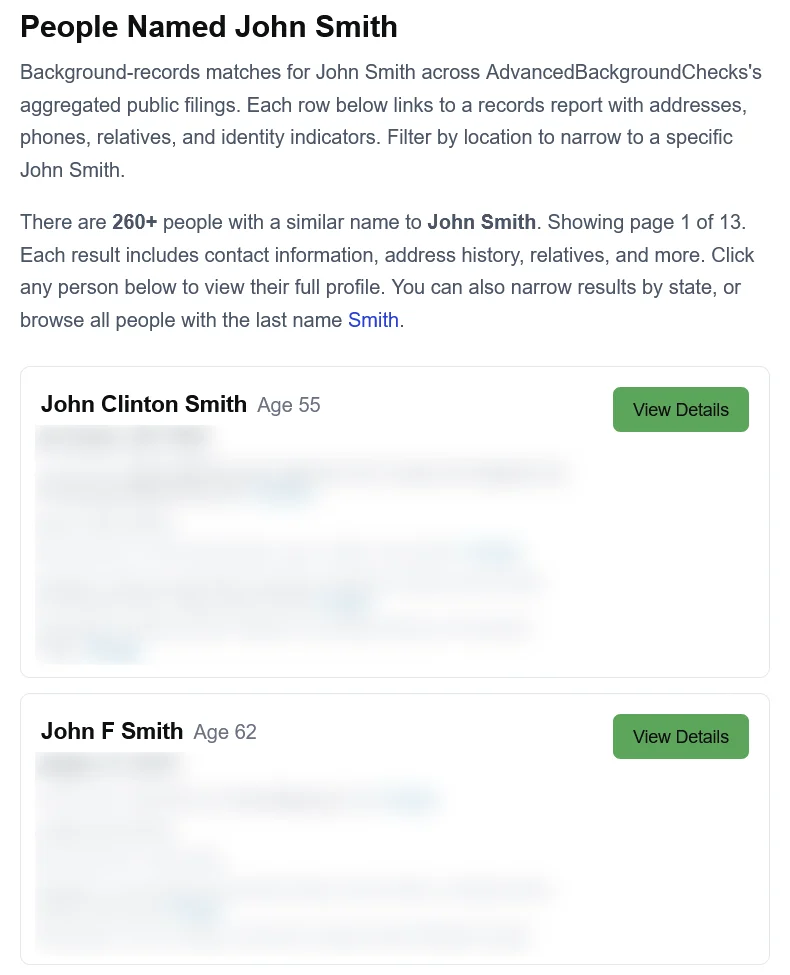
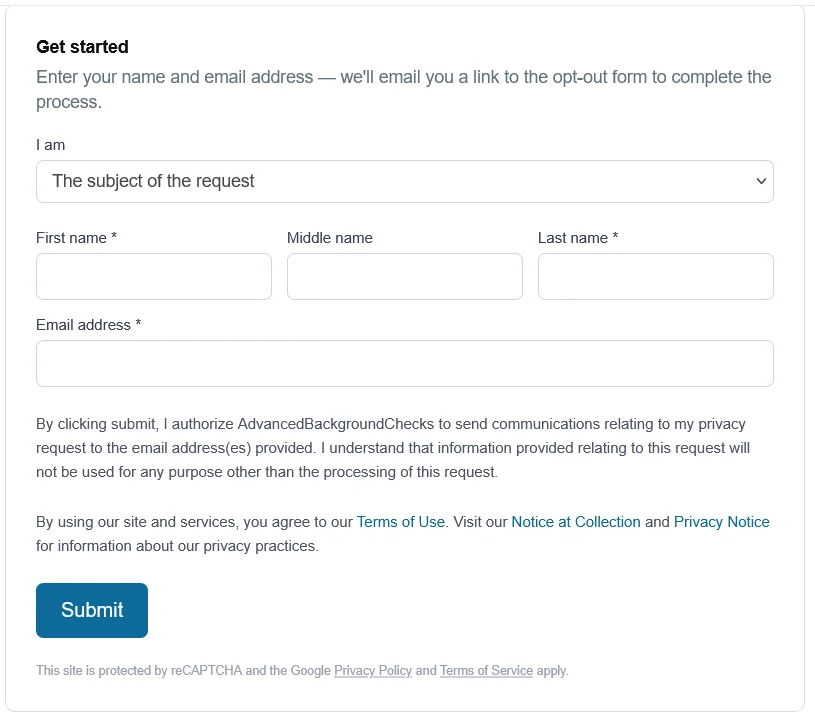
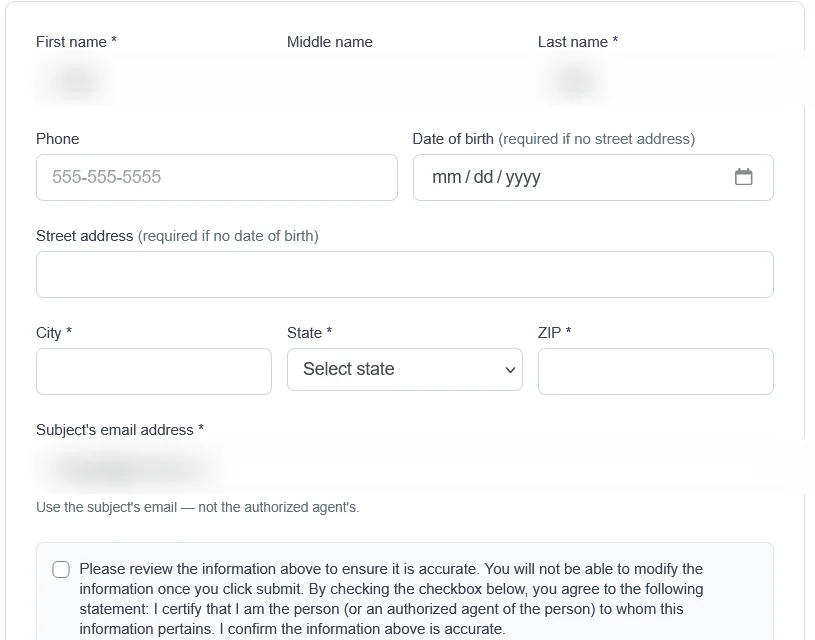
[email protected] with the subject "Complete your advancedbackgroundchecks.com Privacy Request," signed "advancedbackgroundchecks Compliance." Ours arrived within minutes; check your spam folder if it hasn't. Click Click here to fill out the form. The email warns: "If you waited longer than 24 hours to click the link below, you will need to start over and generate another link."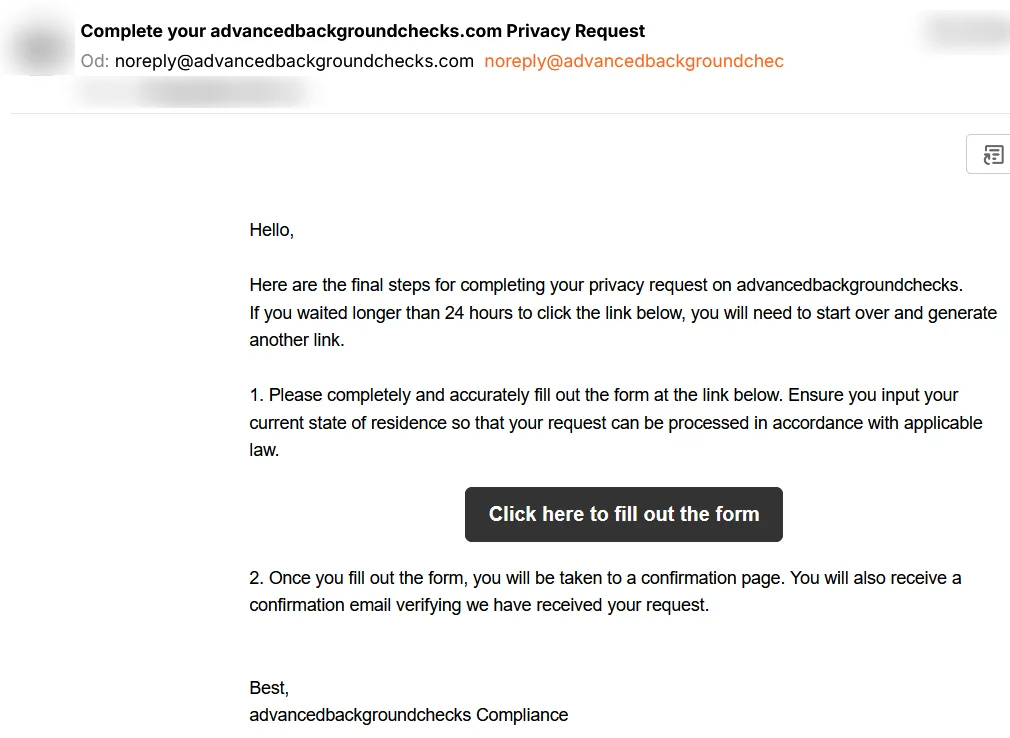
Skip the "Unlimited Background Details" Button
Searching AdvancedBackgroundChecks is free, but two things on its record pages aren't:
- "Get Unlimited Background Details." The red button at the top of every record leads to AdvancedBackgroundChecks PRO (pro.advancedbackgroundchecks.com). It runs a progress screen ("We're building John's report") that ticks through criminal records, court records, liens, social media, employment, bankruptcy, and property, shows a "Report Preview," and then asks you to "Unlock the full report." That's a monthly subscription, not a one-time report: $19.88 a month for up to 50 reports or $49.98 a month for up to 250, with the more expensive plan preselected and billing "until I cancel."
- "Public Records for … Sponsored by." Further down, boxes sponsored by TruthFinder, Spokeo, PeopleFinders, and BeenVerified list more people with your name. Each "View Details" button there leads to that company's site.
AdvancedBackgroundChecks' privacy notice says that if you click on one of its business partners' offers, it "may redirect you to, and share your information with, our business partner." You don't need a report to opt out, and the opt-out never asks for payment. The sponsors are separate companies with their own records about you; to remove yourself from them, see our PeopleConnect guide (TruthFinder), Spokeo guide, PeopleFinders guide, and BeenVerified guide.
AdvancedBackgroundChecks, FastPeopleSearch, and TruePeopleSearch
AdvancedBackgroundChecks never names the company behind it. Its Terms of Service only say "AdvancedBackgroundChecks ('Company')," with a mailbox in Billings, Montana, for legal notices. California's data broker registry fills in the gap:
- One operator, ten sites. Mississippi Tornado Alley LLC is registered as a data broker and lists advancedbackgroundchecks.com among the sites it operates, along with FastPeopleSearch, USPhoneBook, SearchPeopleFree, CyberBackgroundChecks, PeopleSearchNow, USA People Search, SmartBackgroundChecks, and FastBackgroundCheck.
- Same request figures. AdvancedBackgroundChecks' 2025 figures below are identical, number for number, to those published by FastPeopleSearch, SearchPeopleFree, USPhoneBook, and CyberBackgroundChecks.
- Same opt-out system as TruePeopleSearch. The same "Get started" form, the same "Compliance" email asking for your state of residence, the same 24-hour link, and the same final form as TruePeopleSearch and FamilyTreeNow. Those two are registered under other company names, but at the same Sacramento address as Mississippi Tornado Alley.
The registry entry also says something the sites themselves don't: an opt-out of the sale of personal information submitted "on any one of these sites" will be "applied across all of these sites." That could save you some work, but don't rely on it alone. Its exact wording covers the "sale" of personal information, and AdvancedBackgroundChecks says it removes listings built from public records only "as a courtesy." After your AdvancedBackgroundChecks opt-out goes through, search your name on FastPeopleSearch, USPhoneBook, SearchPeopleFree, and CyberBackgroundChecks, and send a request wherever you're still listed. TruePeopleSearch and FamilyTreeNow need their own requests either way.
If Your Opt-Out Is Denied
AdvancedBackgroundChecks' figures for 2025, which cover requests from residents of all US states, show that most opt-outs go through, but deletion requests don't:
| Request type | Received | Completed | Denied | Median reply time |
|---|---|---|---|---|
| Opt out | 4,466,794 | 3,634,288 | 832,506 (19%) | Under 1 day |
| Delete | 11,176 | 0 | 11,176 (100%) | Under 1 day |
| Know (access) | 131 | 97 | 34 | 3 days |
Source: AdvancedBackgroundChecks' U.S. State Supplemental Privacy Notice (section "California Metrics Reporting"), covering January 1 to December 31, 2025.
AdvancedBackgroundChecks says opt-outs were denied when "the data subject was determined to not be a covered consumer under an applicable consumer privacy law," or when it was "unable to locate relevant records in our system." Deletion requests were also denied when it couldn't verify the person's identity. It doesn't say how many fall into each group. For comparison, TruePeopleSearch reports denying 33% of opt-outs in 2025, FamilyTreeNow 42%, and PeopleFinders 70%.
If you're turned down:
- Make sure it isn't a mismatch. A record the site can't find counts as a denial too. Send a new request with your name, address, and ZIP code exactly as they appear on the record, and add your date of birth as well.
- Check whether your state has a privacy law. AdvancedBackgroundChecks names California, Oregon, and Texas as examples; see which US states give you the right to delete your data. Always enter the state you actually live in; the form asks you to certify that your details are accurate.
- Appeal. Its privacy notice says you can appeal through its Privacy Request page, linked from the Privacy Notice at the bottom of every page, or by calling (855) 240-6392. If your state has a privacy law, name it.
- Ask for the courtesy opt-out. If your state has no privacy law, write to
[email protected]and quote its own notice: it "will try to apply your request to the publicly available information we collect, as a courtesy." - Remove the Google result. Google's Results about you tool can remove search results that show your phone number, email, or home address, even if the record stays on AdvancedBackgroundChecks.
What the AdvancedBackgroundChecks Opt-Out Doesn't Remove
- The original records. AdvancedBackgroundChecks says the opt-out "will not remove the data from its original source," so court, property, voter, and other public records stay where they're published.
- Other people-search sites. In its words, "your information may still appear on other websites or be accessible through other services." TruePeopleSearch, Spokeo, Whitepages, and the others each need their own request; for the sites run by the same company, see above.
- New records. AdvancedBackgroundChecks says it regularly receives new public records, "so even if you opt out, your publicly available information may appear in our data products again in the future," and recommends that you "periodically refresh your opt-out request." Searching your name every few months is enough.
- Search engine copies. Google and Bing can show the old page until they visit it again. Use Google's Remove Outdated Content or Bing's Content Removal tool.
- Tracking on the site. The opt-out covers your record, not the cookies AdvancedBackgroundChecks, Google Analytics, and its ad partners set when you visit. Its privacy notice says you also need to change your cookie settings (the "Cookie Management" link at the bottom of the page) or send an opt-out signal such as Global Privacy Control. It doesn't honor Do Not Track.
If Something Goes Wrong
| Problem | What to Do |
|---|---|
| You get "Why have I been blocked?" | AdvancedBackgroundChecks runs Cloudflare and blocks some connections, including many VPN servers. If you use a VPN, switch to a different US server or turn it off for a moment, and try a private window without extensions. |
| No email arrives | Wait a few minutes and check your spam folder for "Complete your advancedbackgroundchecks.com Privacy Request" from [email protected]. If it isn't there, request a new link and check the spelling of your email address. |
| The email link doesn't work | It expires after 24 hours. Start again at the opt-out form to get a new one. |
| You made a mistake in the form | You can't edit a submitted request. Send a new one with the correct details. |
| Your record is still there after the result email | Search again in a private window. If it's still there, send a new request with the details exactly as the record shows them, or call (855) 240-6392. |
| Your request is denied | See If Your Opt-Out Is Denied: check the details, then appeal through the Privacy Request page or by phone. |
| Your record comes back months later | New public records can create it again. Repeat the opt-out; AdvancedBackgroundChecks itself recommends refreshing it periodically. |
Your Other Privacy Rights With AdvancedBackgroundChecks
- Opt out by phone. AdvancedBackgroundChecks lists (855) 240-6392 for opt-outs, privacy requests, and appeals.
- See or correct your data. Use the Privacy Request page linked from its Privacy Notice, or call the same number. AdvancedBackgroundChecks verifies these requests by matching two or three details you give it, such as name, email, and phone number. It answered 97 of 131 requests to know in 2025.
- Deletion. You can ask the same way, but all 11,176 deletion requests in 2025 were denied, so use the opt-out above to remove your listing.
- Authorized agents. Someone else can submit a request for you. AdvancedBackgroundChecks may ask them for a signed authorization and may ask you to verify your identity directly.
AdvancedBackgroundChecks' privacy notice says that "opt-out requests do not require verification" beyond the email link, and that it doesn't process sensitive personal information. It says it is registered as a data broker in Texas and that it is not a Consumer Reporting Agency, so its results can't be used for employment, credit, insurance, or tenant screening. Contact: [email protected].
Live in California? The state's free DROP platform sends one deletion request to every registered data broker at once, including Mississippi Tornado Alley. Do it in addition to the AdvancedBackgroundChecks form, not instead of it.
After AdvancedBackgroundChecks: Where to Opt Out Next
AdvancedBackgroundChecks is only one site. If you want your address off the first page of Google, these are the next ones to tackle:
| Site | Verification | Removal Time |
|---|---|---|
| Spokeo | Email link | 24–48 hours |
| Whitepages | Phone call | Up to 72 hours |
| TruePeopleSearch & FastPeopleSearch | Email link (valid 24 hours) | Up to 3 days |
| BeenVerified, PeopleSmart, PeopleLooker & NeighborWho | Email link | About 24 hours |
| Intelius, Instant Checkmate & TruthFinder | Email link + code to a phone or email in your report | Not stated |
| MyLife | Email code (none in California) | Median 5 days |
| PeopleFinders | Email link (valid 24 hours) | Up to 3 days |
| FamilyTreeNow | Email link (valid 24 hours) | Up to 3 days |
| CyberBackgroundChecks | Email link (valid 24 hours) | Up to 3 days |
| Social Catfish | None (confirmation email) | Within 15 days |
| ThatsThem | None (confirmation email) | Typically 72 hours |
| Nuwber | Email link | Up to 48 hours |
| InfoTracer | None (email confirmation optional) | 24–48 hours |
| PrivateRecords | Email link | Up to 45 days |
To see what your IP address and internet provider already reveal, run the free Data Broker Exposure Report. It's also worth checking whether your email has shown up in a data breach — breached data is another common source for people-search profiles.
Don't Want to Repeat This Every Few Months?
The free form works, but AdvancedBackgroundChecks isn't the only site, and new public records can bring your record back. Paid removal services check people-search sites for you and keep re-submitting opt-outs. If that's worth it to you, see the comparison of Optery, Incogni, and DeleteMe — what each one covers and what it costs.